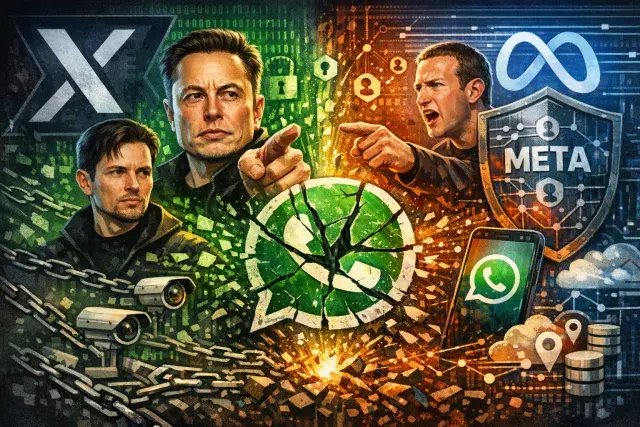
A public broadside from Elon Musk against WhatsApp has reignited one of the most persistent debates in the technology industry: whether the world's most widely used messaging platform can genuinely be trusted to protect private conversations. Musk, responding on X to a report alleging that WhatsApp accesses the content of user messages without consent, declared simply that one "can't trust WhatsApp" — a statement that, given his platform's reach, landed with considerable force. Meta, WhatsApp's parent company, rejected the accusations as "categorically false and absurd," insisting that the app's encryption architecture makes such access technically impossible.
What End-to-End Encryption Actually Means — and Why It Is Being Questioned
WhatsApp uses the Signal Protocol, a widely respected cryptographic standard that applies end-to-end encryption to messages. In practical terms, this means that a message is scrambled on the sender's device and can only be unscrambled on the recipient's device. No intermediate server — including WhatsApp's own infrastructure — should be able to read the content in transit. This design has been in place for roughly a decade and represents a genuine technical commitment to message confidentiality.
The distinction that critics, including Musk and Telegram founder Pavel Durov, appear to be drawing is between message content and everything else. End-to-end encryption protects what you write. It does not inherently protect metadata — information about who you messaged, when, how often, and from where. It also does not govern what happens to data stored in backups, particularly those saved to third-party cloud services, which have historically fallen outside the encrypted envelope depending on a user's settings. This is not a secret flaw; it is a documented complexity that technical communities have discussed for years. But it is also a nuance that most users are unlikely to understand.
The Commercial Context Behind the Dispute
Musk's criticism of WhatsApp did not stop at concern for users. He used the moment to promote X's own direct messaging feature, positioning it as offering "actual privacy." This framing matters. When a platform owner publicly attacks a rival's security credentials while simultaneously promoting their own product, the statement is simultaneously a policy argument and an advertisement. Both elements deserve scrutiny from the reader.
Durov, whose Telegram platform competes directly with WhatsApp for users who prioritize privacy and security, echoed Musk's concerns, alleging that WhatsApp misleads users about encryption while sharing data with third parties. Meta has not addressed these specific allegations in detail beyond its blanket denial. The pattern here is familiar: competing platforms have strong commercial incentives to amplify doubts about each other's security practices, which makes independent technical assessment more valuable — and harder to find — than any party's public statement.
A Trust Problem That Encryption Alone Cannot Solve
The broader issue this dispute exposes is the gap between technical security and user trust. WhatsApp may well encrypt its messages correctly and completely. That does not resolve questions about how Meta handles the non-message data it collects — account information, device identifiers, usage patterns, contacts — which can be commercially valuable and is subject to Meta's broader data practices. Users who are uncomfortable with Meta's data model have legitimate grounds for concern that exist entirely independently of whether message content is encrypted.
This distinction is frequently lost in public debates about messaging security. Encryption is a specific technical property. Privacy, as users experience it, is a broader condition that includes what a company knows about your behavior, who it shares that with, and under what legal or commercial circumstances. A platform can be genuinely encrypted and still collect substantial behavioral data. These are not contradictory positions.
What Users Should Actually Consider
For people trying to make informed decisions about which messaging platform to use, the practical considerations are worth separating from the noise of this dispute. WhatsApp's message encryption is real and technically sound by established standards. The questions worth asking are different ones: whether cloud backups are encrypted end-to-end on your specific device settings, what metadata the platform retains, and how comfortable you are with Meta holding your contact graph and usage patterns. These are questions any serious review of messaging privacy should address — and they are not answered by either Meta's denial or Musk's post on X.
What this episode demonstrates, above all, is that public trust in digital infrastructure is fragile and easily disrupted by statements from high-profile figures, regardless of technical accuracy. For the billions of people who rely on messaging apps daily, that fragility is not a minor inconvenience. It is a condition that shapes decisions about communication, safety, and personal exposure in ways that deserve more careful public conversation than a back-and-forth between platform owners on social media.